


A20 Pro Next Generation Processor
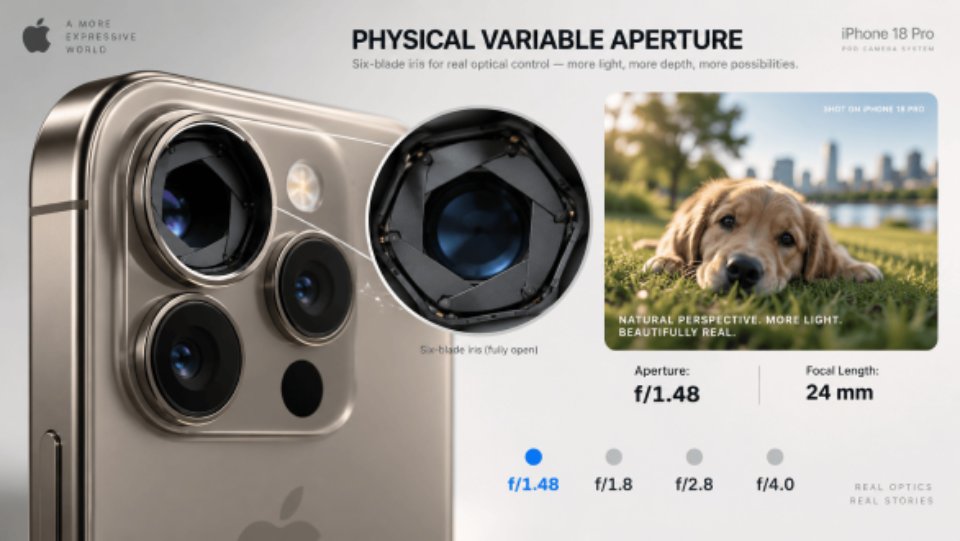
Why Apple finally moved from fixed aperture iPhone imaging to a physical variable iris – and what the patent architecture says about the journey?
The big shift in iPhone 18 Pro is not merely that the camera can show four aperture values. The deeper shift is architectural: light control is once again happening optically, before the ISP decides how much Night mode, tone mapping, sharpening or synthetic blur it needs. That makes variable aperture one of the most important camera changes in recent iPhone history.
01 The A20 Pro at a Glance
Architectural element | Apple-disclosed specification |
Fabrication | Latest 2-nanometer process technology |
CPU | Six cores: two super cores and four efficiency cores |
GPU | Seven cores with Neural Accelerators; hardware-accelerated ray tracing |
Neural processing | Dual 16-core Neural Engine (32 cores in total) |
Memory bandwidth | 50% more than A19 Pro |
Packaging | Processor silicon positioned side by side with memory |
Cooling | Processor directly coupled to redesigned vapor chamber |
The key story is a system-level redesign: additional compute capability is valuable only if energy delivery, data movement, and sustained heat removal scale with it. Apple states up to 40% faster GPU performance, twice the Neural Engine AI processing power, and 50% higher memory bandwidth compared with A19 Pro, these are vendor-stated comparisons, not universal application speedups.
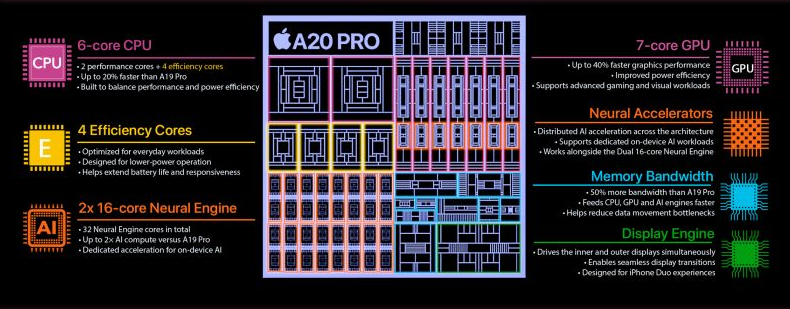
Image source: Andrew Chan’s LinkedIn post
*Note: This third-party illustration is provided for conceptual reference; its internal block placement is unverified. Apple’s official specifications identify a six-core CPU with two super cores and four efficiency cores, rather than the “performance cores” terminology used in the image.
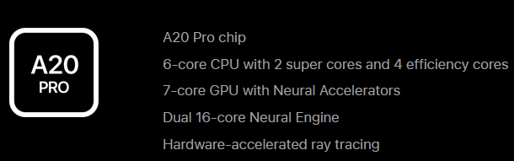
Image Source: Apple’s technical specifications
02 The 2 nm System-on-Chip
More computing per area, subject to the power and thermal budget
A20 Pro is built using a 2 nm-class semiconductor process. “2 nm” denotes a foundry technology generation; it is not a literal measurement of every transistor dimension. A more advanced process can permit improved transistor scaling and energy-versus-performance tradeoffs. Still, actual gains depend on transistor libraries, interconnect resistance, operating voltage, clock target, SRAM design, and chip-level physical implementation.
For a mobile SoC, the design challenge is to integrate the CPU, GPU, neural computation, caches, memory interfaces, imaging-related functions, and system control within strict package volume and battery constraints. Higher effective computing density may allow more functional units or on-die memory in a limited silicon area. It does not establish that every block becomes proportionally smaller or that a particular percentage reduction in power is achieved.
- Compute density: potential for increased logic integration per unit silicon area; A20 Pro die size and transistor count have not been disclosed by Apple.
- Energy efficiency: a process improvement can lower energy per operation at chosen performance points, while SoC-level efficiency also depends on active power, leakage, data movement, and utilization.
- Sustained performance: Apple’s side-by-side packaging and redesigned vapor chamber address heat removal; this is distinct from the benefits of transistor scaling.
US8130009B2 – Dynamic voltage and frequency management. Apple discloses integrated circuit techniques for changing voltage and operating frequency to manage power and performance.
US9411404B2 – Coprocessor dynamic power gating for on-die leakage reduction. Apple describes selectively power-gating coprocessor circuitry to reduce leakage. It illustrates the kind of power-domain strategy useful in heterogeneous SoCs, without confirming an A20 Pro-specific circuit.
03 Neural Accelerators Inside the Processor
AI computation is not confined to one dedicated engine
Apple’s published specifications list a six-core CPU, seven-core GPU with Neural Accelerators, and a dual 16-core Neural Engine. Its launch announcement also describes Neural Accelerators integrated into the CPU. These are distinct disclosed compute resources; the Apple product materials cited here do not specify their internal Datapath widths, accelerator counts, memory connections, or a universal rule for assigning machine-learning operators.
CPU + integrated neural features | GPU + Neural Accelerators | Dual Neural Engine |
Control flow, general operators, latency-sensitive execution | Parallel data processing, graphics and supported ML operations | Dedicated AI-model computation and computational photography |
Shared system memory/data movement (conceptual) | Shared system memory / data movement (conceptual) | Shared system memory / data movement (conceptual) |
The technical reason for distributing AI processing is workload heterogeneity. Branch-heavy preprocessing, highly parallel tensor or image operations, and neural-network inference place different demands on instruction control, memory locality, numeric precision, and parallelism. A system can improve performance per watt by executing supported operations on more suitable hardware, if transfer and synchronization overheads do not erase the advantage.
- CPU: general-purpose sequencing and operations that may not map efficiently to fixed-function or massively parallel hardware.
- GPU: high-throughput parallel processing; the A20 Pro technical specification explicitly identifies GPU Neural Accelerators.
- Neural Engine: dedicated computation for on-device AI models and computational photography; Apple claims twice the AI processing power of A19 Pro.
US20240265233A1 – Scalable neural network processing engine. Apple describes scalable hardware for neural-network operations. It provides technical background for specialized neural-processing engines, not evidence of the A20 Pro core-level organization.
US11580353B2 – Neural network processor for handling differing datatypes. Apple describes processor techniques for differing data types, relevant to the precision and format challenges of AI arithmetic. Supported formats inside A20 Pro remain undisclosed in the cited product materials.
US11740932B2 – Systems and methods for task switching in neural network processor. Apple describes task-switching techniques in neural-network processing hardware. The patent does not verify A20 Pro scheduling circuitry.
04 Increased Memory Bandwidth
Feeding the execution engines matters as much as adding them
Apple explicitly states that A20 Pro provides 50% more memory bandwidth than A19 Pro. The iPhone Duo announcement calls this “unified memory bandwidth.” That is a comparative throughput claim, not a disclosure of an exact GB/s rate, DRAM generation, physical bus width, or channel count.
For local AI inference, model parameters and intermediate activations must be moved to the processing engines. Larger models, longer input contexts, higher-resolution images, and concurrent applications increase capacity and/or transfer pressure. A higher-bandwidth memory subsystem can reduce stalls when a workload is bandwidth-bound, but it does not by itself increase physical RAM capacity or guarantee that every model will fit locally.
- Weight streaming: accessing model parameters can consume substantial external-memory bandwidth when working sets exceed local caches.
- Activation traffic: repeated intermediate reads and writes can dominate energy if data reuse is poor.
- Compute-memory balance: available arithmetic throughput yields practical benefits only when the required operands arrive fast enough.
US12468926B2 – Circular buffering in neural network processor. Apple describes circular buffering associated with neural-network computation, illustrating ways to reuse storage and manage dataflow. The specific buffering design in A20 Pro is not confirmed.
US20260134272A1 – Memory-efficient streaming convolutions in neural network processor. Apple describes techniques targeting efficient convolution data movement. This pending application is relevant to reducing memory pressure in inference but does not establish A20 Pro implementation.
05 How Packaging Changes the Memory Story
A lateral processor–memory arrangement makes thermal integration easier
Apple says A20 Pro uses custom packaging, inspired by its M-series silicon, that places the silicon die side by side with memory. This removes memory from the processor’s direct thermal path and allows the chip to attach directly to a next-generation vapor chamber. The vapor chamber provides three times the surface area of the previous generation’s design on iPhone 17 Pro, and with A20 Pro and improved thermal materials, it enables up to 40% better sustained performance than iPhone 17 Pro. Separately, Apple reports up to 35% better sustained performance for iPhone Duo compared with iPhone 17 Pro.
Earlier stacked arrangement (concept) | A20 Pro side-by-side arrangement (Apple disclosure) |
DRAM placed over the application processor in a PoP-style stack | Processor silicon and memory placed laterally in a custom package |
Stack geometry may complicate direct heat removal from processor silicon | Memory is removed from the processor thermal path |
Thermal interface and cooling depend on device-specific assembly | A20 Pro attaches directly to the redesigned vapor chamber |
A lateral package is not the same as embedding DRAM cells inside the CPU silicon die. Nor does Apple’s statement establish use of a named 2.5D interposer, a particular redistribution-layer stack, a specific chiplet-to-chiplet interface, or any bonding pitch. Those features would require package cross-sections or additional Apple documentation.
06 What the A20 Pro Is Really Optimizing
Fabrication, execution, and memory form one coupled performance system
SILICON | NEURAL COMPUTE | MEMORY + THERMALS |
2 nm-class integration; improved power/performance design envelope. | CPU/GPU/neural hardware provides specialized computation for different tasks. | 50% more bandwidth, lateral memory package, and improved processor cooling. |
The A20 Pro is important because Apple is scaling not only arithmetic throughput, but also the infrastructure needed to use it: memory access, workload-specific acceleration, and sustained cooling. The practical benefit for heavier local AI workloads comes from their interaction. A process improvement alone does not eliminate memory stalls; additional neural cores alone do not create model capacity; and a faster memory interface alone does not guarantee faster inference.
For a patent analyst, the strongest publication-ready conclusion is therefore narrow: Apple confirms a 2 nm A20 Pro SoC with distributed neural compute resources, a dual Neural Engine, a substantial generational bandwidth increase, and a revised processor–memory thermal arrangement. Detailed transistor structures, internal neural scheduling, and memory-controller implementation require independent, claim-specific evidence before being mapped as shipped features.
https://www.apple.com/iphone-18-pro/
https://www.apple.com/newsroom/2026/09/apple-unveils-iphone-duo/

Leave a comment: