


The newest patent story is not that Apple invented a shutter button. It is that the iPhone can interpret the same physical control as different camera commands depending on pressure, touch movement and context. Apple shipped the core Camera Control architecture on iPhone 16 in 2024; the September 2026 continuation, US20260270547A1, shows the IP program continuing after launch, including pressure-dependent camera operations. The interesting question is therefore not “when did Apple add a button?” but “how did Apple convert one narrow strip on the frame into a compact input language?”
1. Before Camera Control: iPhone photography was still display first
Before iPhone 16, users could trigger the camera with the on-screen shutter, volume keys, lock-screen shortcuts or the Action button, but fine adjustments still depended heavily on the display. That works, but it breaks the camera-like capture loop: the shooting finger leaves the frame edge, UI controls occupy viewfinder space, and focus/exposure adjustment is separated from the physical capture gesture. Apple’s own later patent background describes over-reliance on displayed controls as potentially cumbersome, distracting and error prone.
The requirement was therefore specific: preserve a clean edge, avoid multiple dedicated buttons, keep the viewfinder unobstructed, and still provide camera-style staged input – contact, light press, movement and full press – with software interpreting each state.
2. Competitors have solved pieces of the problem – in different ways
Sony Xperia established the classic phone-camera model with a dedicated camera key that can be half-pressed for focus and fully pressed for capture. OPPO’s Find X8 Pro later used a touch-sensitive Quick Button for launch, capture, burst and swipe-to-zoom. vivo pushed the concept further on X200 Ultra with a two-stage pressure-sensitive control that supports light-press AF/AE locking, heavier-press capture and swipe-based parameter adjustment. These approaches validate the user’s need, but they do not all solve the same interface problem or use the same sensing stack.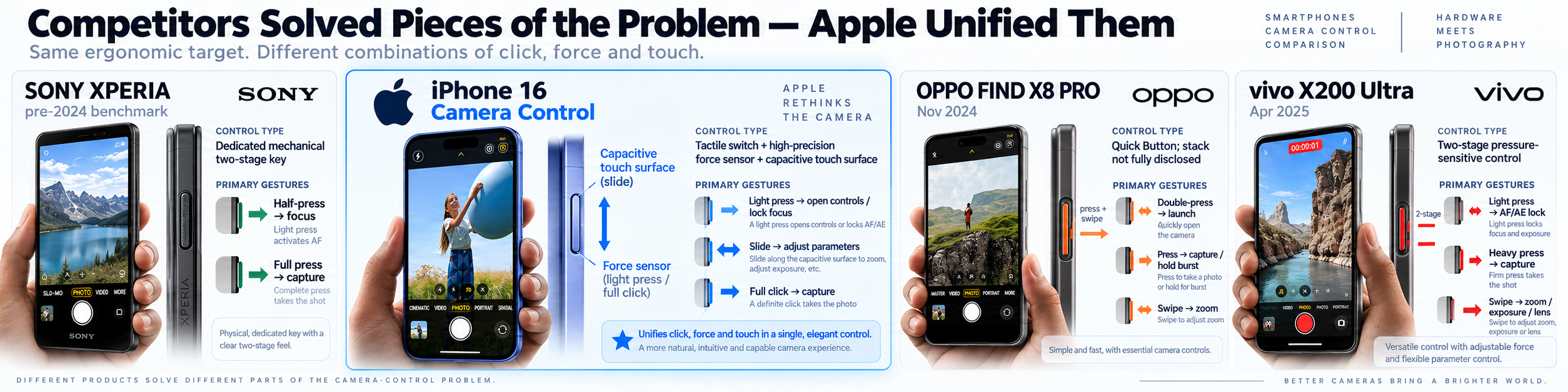
3. Apple’s R&D path: from button states to a camera-control grammar
For the camera-specific patent line, the earliest verified priority we found is September 29, 2023 (U.S. provisional 63/541,755). That family later produced applications such as US20250110574A1 and grants including US12,666,132 and US12,671,891. The core idea is not merely “press to shoot.” It is thresholded behavior: a press below a first threshold can change the camera interface or prepare capture, while a press above the threshold can trigger media capture.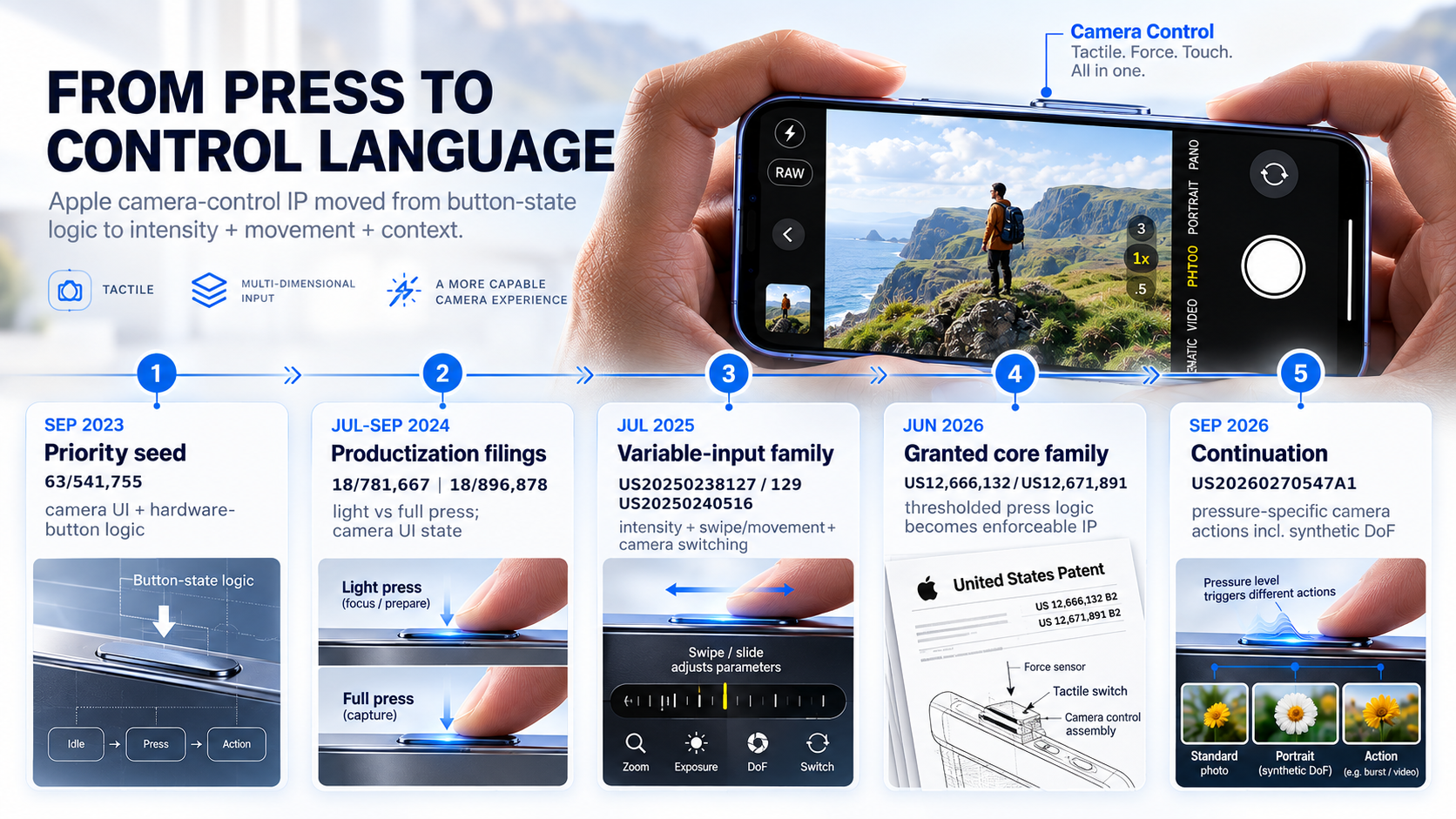
4. 2024-2025: Apple expands one control into intensity + movement + context
The January-September 2024 provisional cluster, later reflected in US20250238127A1, US20250238129A1 and US20250240516A1, broadens the interaction model. The disclosures cover variable hardware inputs, different operations based on press intensity, movement while pressing, camera switching, customizable controls near the hardware input and viewfinder changes. The hardware button may be mechanical or solid-state and may include pressure, touch, capacitive or motion sensing.
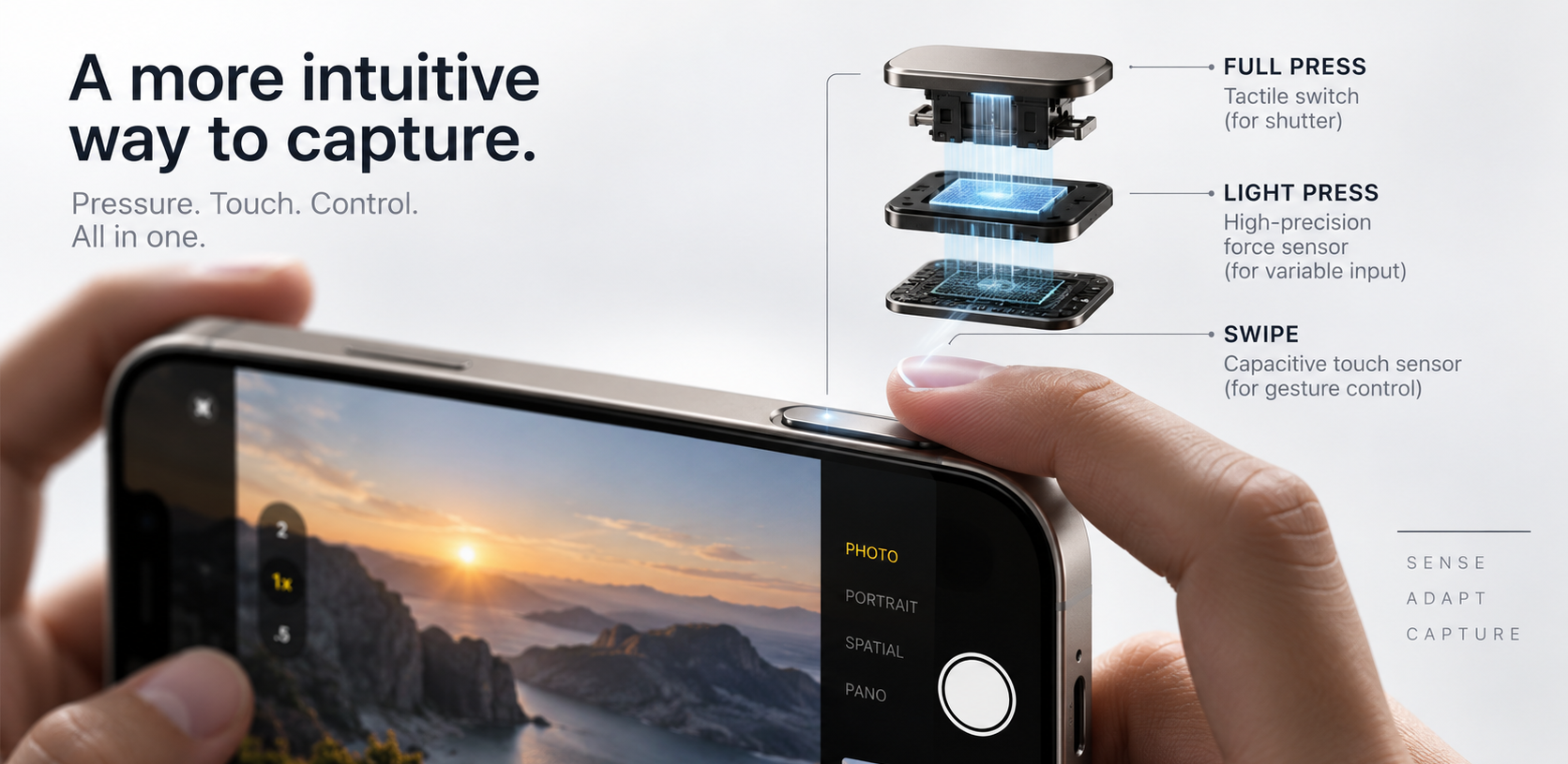
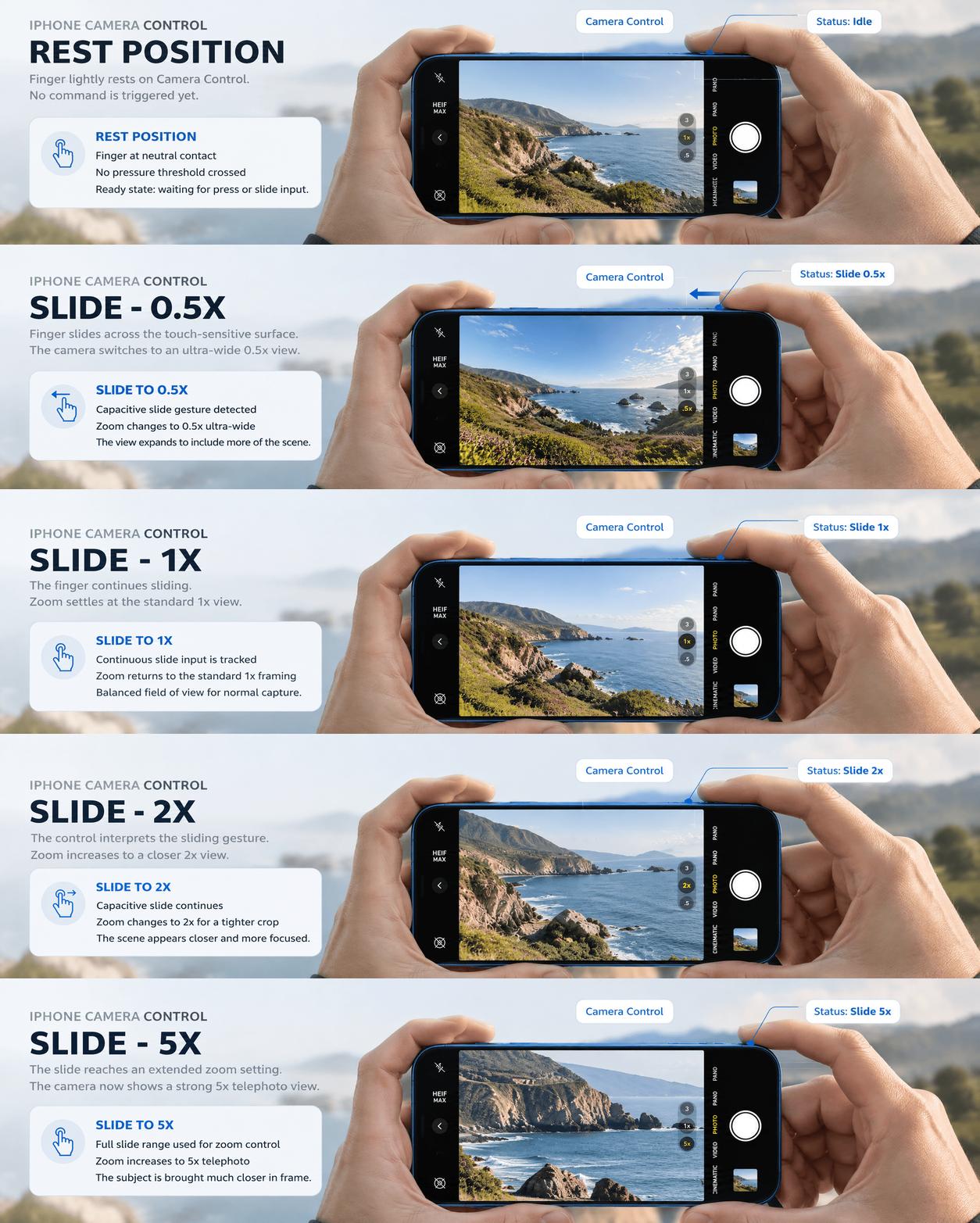
That architecture maps closely to the shipping iPhone 16 Camera Control announced in September 2024: Apple describes a tactile switch for the click, a high-precision force sensor for light press, and a capacitive sensor for touch interactions. A light press can expose an overlay; sliding adjusts values such as zoom, exposure or depth; a click captures. Apple also announced a two-stage shutter behavior for focus/exposure lock before capture.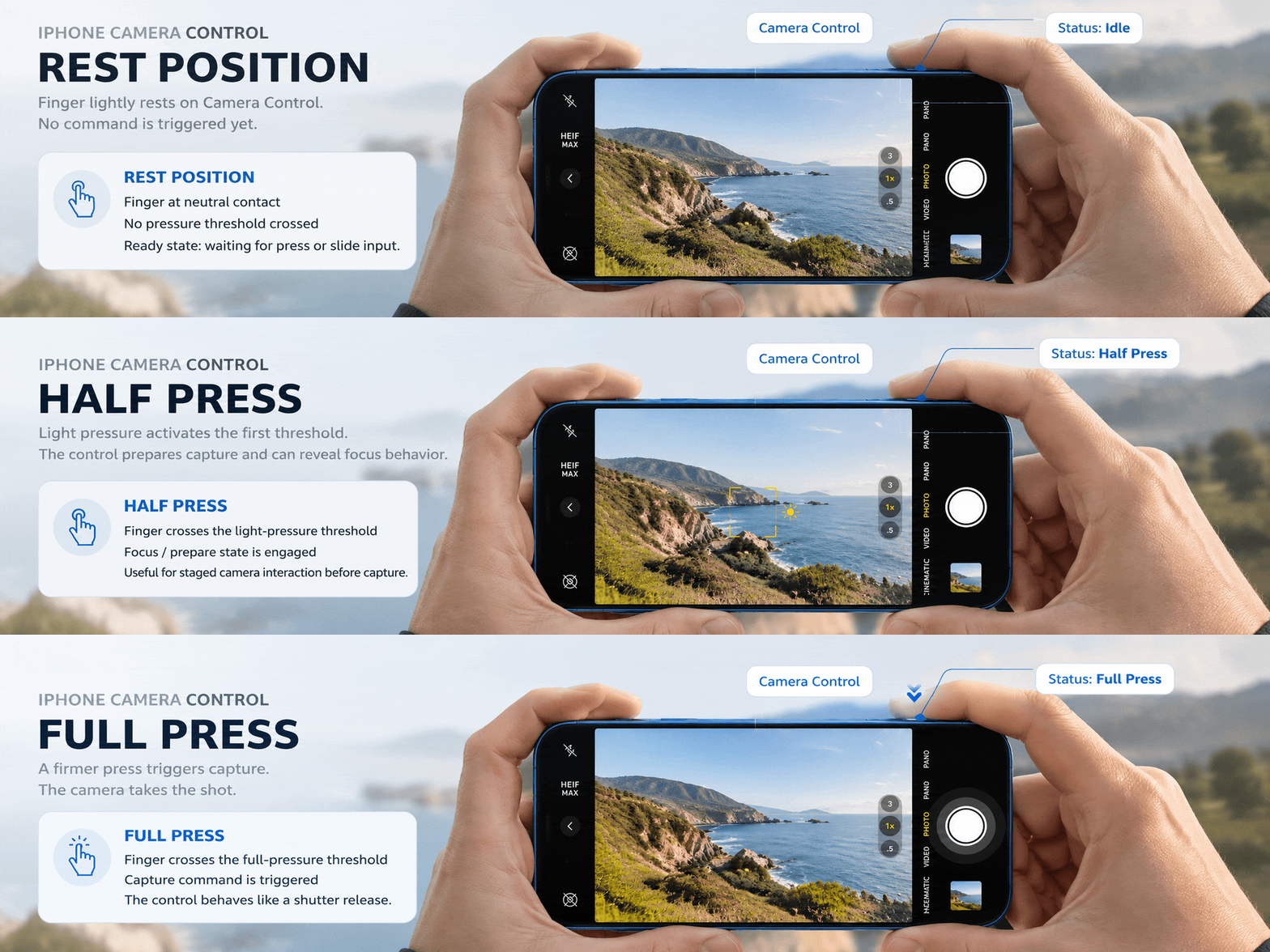
5. 2026: the continuation makes pressure itself part of the camera command
US20260270547A1, published September 10, 2026, continues the 2023 family. One camera embodiment distinguishes lower- and higher-pressure presses: the first can trigger a synthetic depth-of-field operation, while the second performs media capture. Other embodiments map press types to settings or interface behavior – protecting the interaction logic around the sensor, not merely the sensor itself.
6. Why the product decision became a hybrid control, not a simple shutter
A conventional camera shutter already proves the value of two-stage pressure. Apple’s product decision adds a second dimension: lateral capacitive movement. That means one control can behave like a shutter button, a compact parameter dial and a context-sensitive UI trigger. The combination avoids dedicating separate physical controls to zoom, exposure, depth and capture, while keeping those operations under the same finger.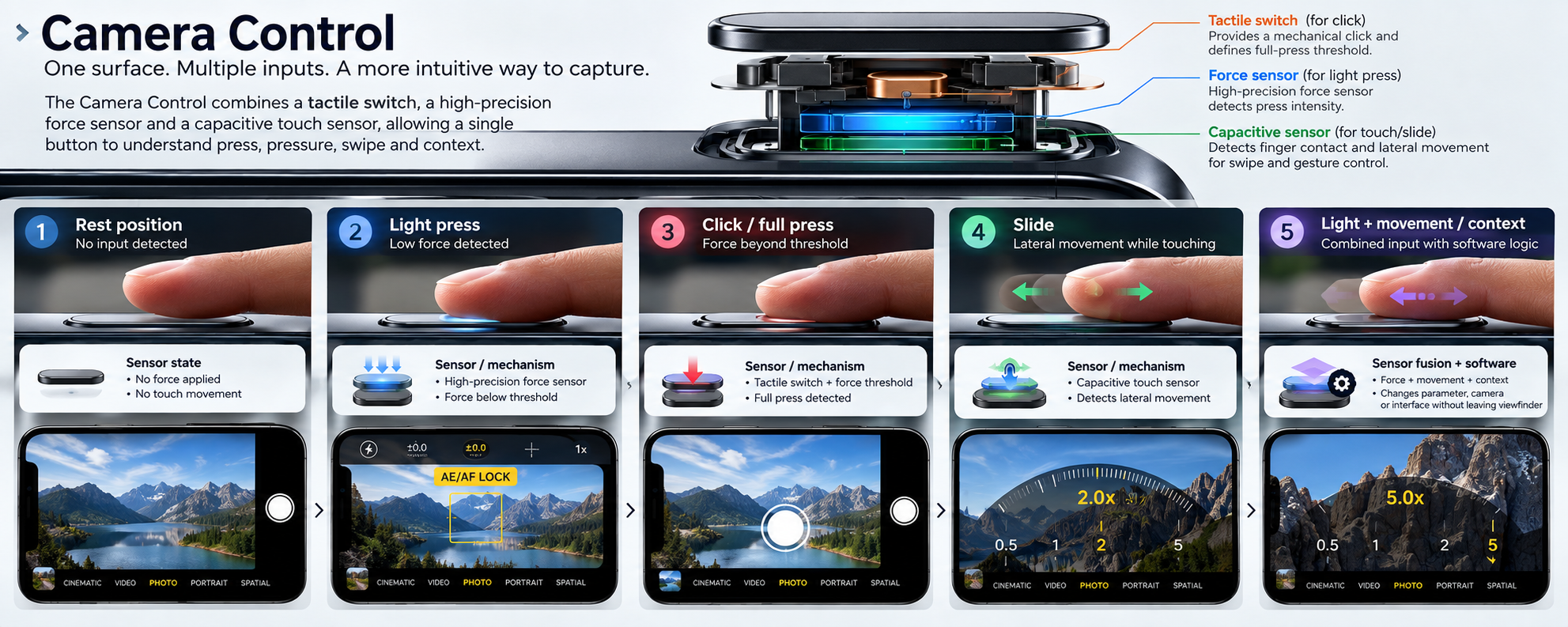
7. What earlier iPhones lacked – and what this architecture fixes
The limitation was not image quality; it was capture ergonomics. Earlier iPhones could already focus, meter, zoom and shoot, but those actions were split between touchscreen UI and generic buttons. Camera Control collapses those functions into a dedicated edge interface with force discrimination and touch movement. Apple also exposes sensitivity controls so users can change the light-press force and double-light-press timing, which addresses accidental activation and individual grip differences as part of the system design rather than treating them as fixed hardware behavior.
8. IP strategy takeaway: protect the control grammar, then keep extending it
Apple was not first to put a dedicated camera key on a phone, and the record does not support describing competitors as “hit and trial.” What the chronology does show is a portfolio-driven development pattern: establish the pressure-threshold camera logic in 2023, expand it through a dense 2024 family covering intensity, movement and context, ship a hybrid force + capacitive + tactile implementation in 2024, and continue prosecuting narrower interaction concepts through 2026. That sequence gives Apple room to test multiple software/hardware behaviors while protecting the interaction layer around the control.
The result is less about adding another button and more about converting a narrow piece of the iPhone frame into a programmable camera surface. The next meaningful development to watch is not another sensor, but how Apple maps pressure levels, swipe trajectories and camera context into fewer, more predictable capture states – especially as the 2026 continuation pushes pressure-dependent behavior deeper into camera operations.
Key sources
- Apple Newsroom (Sep. 9, 2024), iPhone 16 / 16 Pro Camera Control: tactile switch, high-precision force sensor and capacitive sensor.
- US20250110574A1 / US12,666,132; US12,671,891 – User Interfaces Integrating Hardware Buttons (priority Sep. 29, 2023).
- US20250238127A1; US20250238129A1; US20250240516A1 – variable hardware input / camera-control family (2024 priority cluster).
- US20260270547A1 – User Interfaces Integrating Hardware Buttons, published Sep. 10, 2026; continuation of the 2023 family.
- Sony support: Xperia dedicated Camera key / half-press focusing. OPPO Find X8 Pro: Quick Button. vivo X200 Ultra: two-stage pressure-sensitive camera control.