


iPhone 18 Pro: Building Trust Into Every Photo
Authenticated imaging, secure capture, Apple patents, and a cross-brand provenance comparison
As AI-generated and heavily edited images become increasingly realistic, visual appearance alone is no longer enough to establish where a photograph came from. Apple’s iPhone 18 Pro introduces Apple Reference Image, an opt-in system designed to create trustworthy evidence of what the camera sensor captured and to preserve that evidence for later verification.
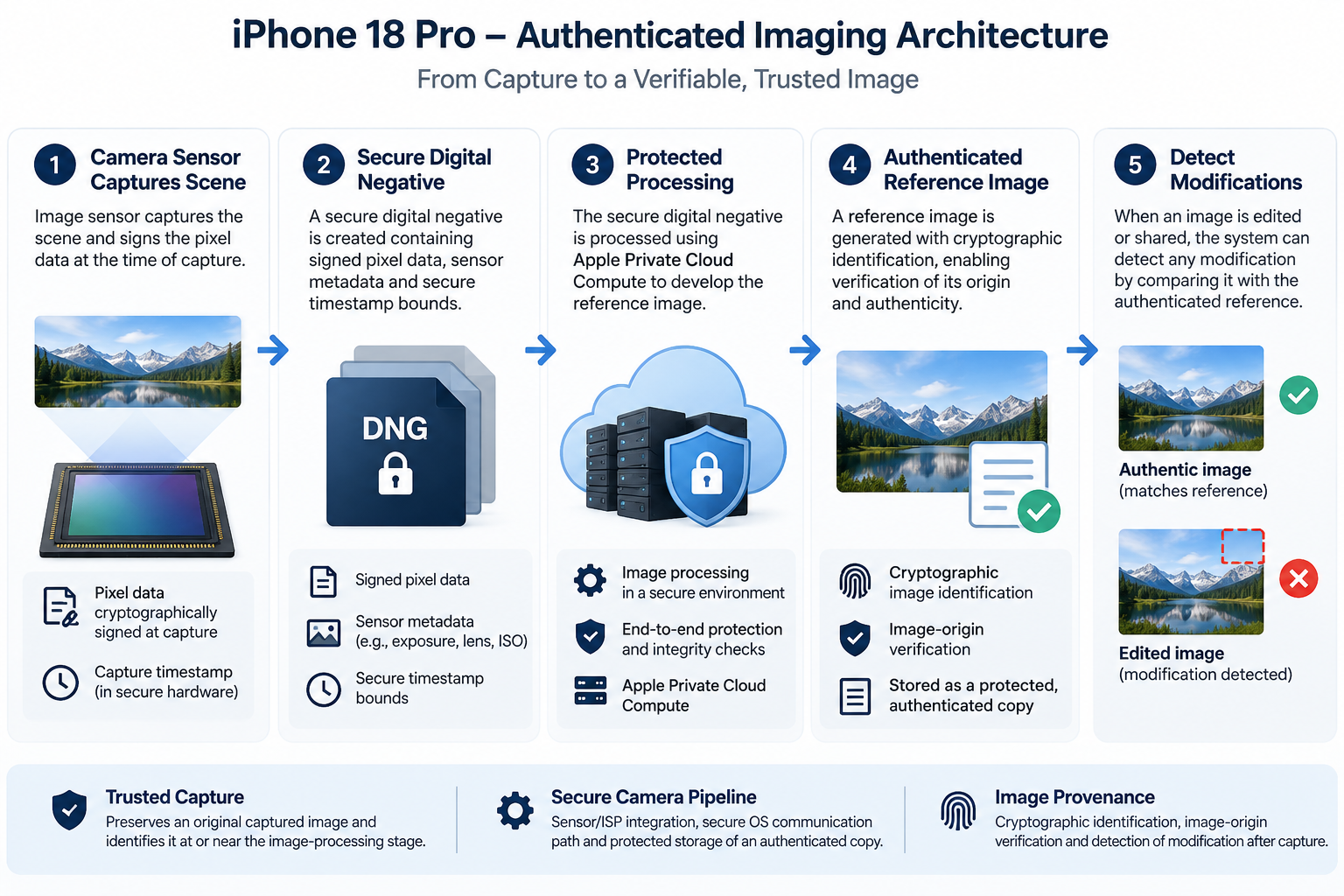
Figure 1. Simplified authenticated-imaging flow for iPhone 18 Pro.
1. Authenticated Imaging Architecture
The central idea is to preserve a trusted baseline close to the moment of capture. In Reference mode, the Main camera sensor cryptographically signs captured pixel data and sensor-produced metadata. Apple then uses protected processing to develop this signed data into a reference image that can be compared with the normal photograph later.
Trusted Image Capture
Preserving an original captured image. A secure digital negative preserves signed sensor data before later photo edits can redefine what the image appears to show.
Image identification at or near the image-processing stage. Signing occurs at the sensor at capture time rather than being added only after the ordinary imaging pipeline has completed.
2. Secure Camera Pipeline
Sensor / ISP integration. Apple describes a specialized reference-capture mode in which the sensor signs pixel data immediately after capture. This provides stronger assurance that the image data entering the system came from the physical sensor rather than being injected later in software.
Secure operating-system and processing path. Sensor-originated data is protected cryptographically; selected off-sensor metadata can be signed by the Secure Enclave. Apple then uses Private Cloud Compute to develop the secure digital negative in a verifiable processing environment.
Protected authenticated copy. The resulting reference image is retained as a trusted comparison point. Users can view it alongside the normal image to identify later crops, color changes, generative edits, or other modifications.
3. Image Provenance
Cryptographic image identification. Apple uses cryptographic signatures to bind captured data to the trusted capture path. Apple states that the final public reference-image signature uses a composite post-quantum design combining RSA-3072 and ML-DSA-87.
Image-origin verification. Verification checks can establish that the reference image was produced from a valid Apple sensor/device pairing and processed through the expected protected workflow.
Detection of modification after capture. The normal photo can be compared against the authenticated reference. If content diverges, the difference provides evidence that the ordinary image has changed since capture.
4. Apple Patents Related to Secure and Authenticated Imaging
Apple’s patent portfolio contains disclosures that align with different layers of this architecture. The first filing below is the closest match to authenticated-photo verification; the others show related secure-sensor and trusted-processing concepts. Patent disclosures do not by themselves prove that every claimed feature is implemented in the commercial iPhone 18 Pro.
Apple patent | Title | Relevant disclosure | Connection to architecture |
US20260268025A1 | Authenticated Images | Creates a copy of camera data in an OS layer inaccessible to applications; sends it through a secure communication channel to protected storage; later compares a shared image against the stored representation. | Directly relevant to original-copy preservation, secure OS transfer, protected storage, and alteration checking. |
US12182319B2 | Software initiated camera and microphone indicator | Describes an electronic device with an image sensor, secure processor, application processor, and protected handling of sensor activation and data paths. | Related to secure camera/OS architecture and trusted sensor access, although it is not an image-provenance patent. |
US11682278B2 | Data-secure sensor system | Uses a trusted environment for image/video sensor data and limits external access to raw imagery while allowing protected analysis. | Relevant background for isolating sensitive camera data and keeping raw sensor content within a trusted processing environment. |
5. How Apple’s Approach Compares with Other Brands
The major smartphone makers are converging on cryptographic provenance, but they are not using exactly the same architecture. The comparison below focuses on publicly documented capabilities as of September 2026.
Platform | Capture proof | Provenance model | Edit transparency | Distinctive strength |
Apple iPhone 18 Pro | Pixel data signed at the Main camera sensor in Reference mode. | Apple Reference Image creates a secure digital negative and authenticated reference image. | Reference image can be compared with the normal photo to expose later changes. | Trust begins at the sensor; protected development in Private Cloud Compute; secure timestamps, revocation, and post-quantum final signatures. |
Google Pixel 10+ | Hardware-backed C2PA implementation using Tensor G5, Titan M2, Android security, and trusted on-device timestamps. | C2PA Content Credentials attached by Pixel Camera to supported JPEG captures. | Credentials describe origin and editing history; Google Photos can display them. | Strong standards-based interoperability, privacy-preserving certificate management, and offline trusted timestamps. |
Samsung Galaxy S25/S26 family | C2PA/Content Credentials support is integrated into Galaxy workflows; supported Qualcomm platforms also provide capture-time cryptographic sealing capabilities. | C2PA is used to communicate provenance and AI-related creation/editing information. | Galaxy generative edits can carry visible and invisible provenance/watermark signals. | Broad C2PA adoption and clear AI-edit transparency across the Galaxy content workflow. |
Snapdragon/Truepic ecosystem | Supported Snapdragon ISP platforms can create a cryptographic seal at capture. | C2PA/Truepic provenance can be carried across compatible devices and apps. | Provenance records can indicate capture and later processing. | Cross-manufacturer architecture that can bring authenticated capture to multiple Android brands. |
What Is the Main Advancement?
Apple’s most distinctive advancement is moving the trust anchor closer to the physical capture event. Rather than relying only on provenance attached after normal image processing, Reference Image signs data at the camera sensor and preserves a separately authenticated baseline. Google and Samsung, meanwhile, emphasize interoperable C2PA Content Credentials that travel with media and describe creation/edit history. These approaches are complementary: Apple emphasizes sensor-to-reference integrity, while C2PA-centered systems emphasize ecosystem-wide provenance interoperability. |
6. Why This Matters
For journalism, insurance, legal evidence, inspections, field documentation, compliance, and other workflows where photographic proof matters, authenticated capture can make an image more than a visual record. It can provide cryptographic evidence about origin and a reliable baseline for determining whether the content changed after capture.
Leave a comment: