



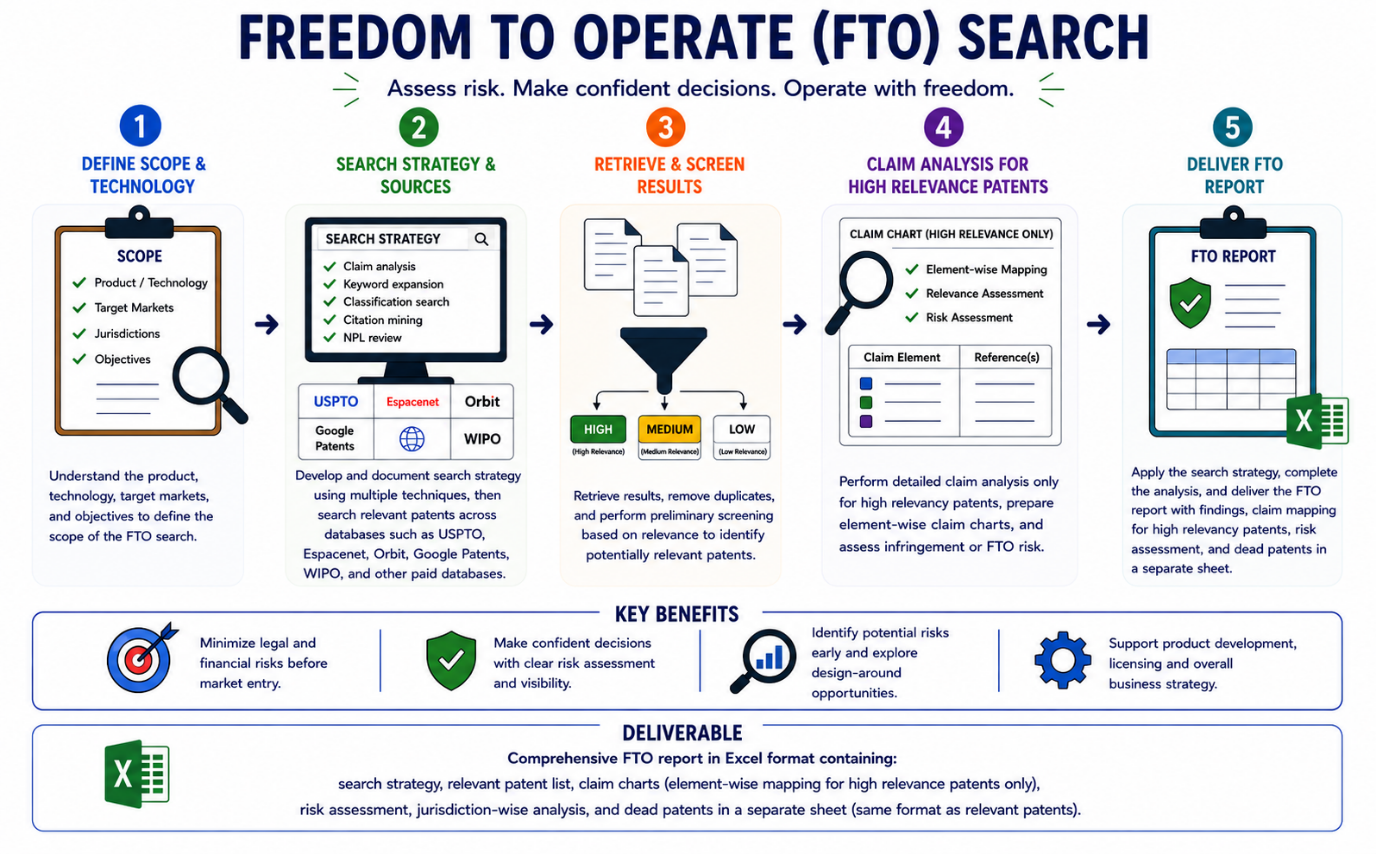
Bringing a new product or technology to market without understanding the surrounding patent landscape can create significant legal and commercial risk. LogicApt’s Freedom-to-Operate (FTO) Search service is designed to help companies, innovators, investors, and legal teams identify potential patent risks before product launch, commercialization, licensing, or market expansion.
An FTO search focuses on identifying active patents and patent applications that may potentially cover specific product features, functionalities, or technologies in a target jurisdiction. Unlike patentability searches, which evaluate whether an invention is novel, Freedom-to-Operate analysis is centered on assessing infringement risk and helping organizations make informed business decisions with greater confidence.
At LogicApt, our FTO process begins with a detailed understanding of the product, technology, or solution under review. We analyze the product features, technical architecture, workflows, and functionalities to identify the core areas that may overlap with third-party patent rights. Based on this analysis, our team conducts extensive searches across patent publications and applications relevant to the technology domain and countries of interest.

Freedom to Operate
Before launching a product or service in the market, it is important to conduct a freedom to operate (FTO) or a clearance search, to assess the risk of a potential infringement and to avoid subsequent litigations. The organizations should proactively perform an FTO search to identify patents that may potentially map the features of the product or service to be launched. Generally, the FTO search is restricted to a particular jurisdiction, however, it is prudent to search for international applications which can potentially enter the target jurisdictions to be sure of obtaining a patent. An FTO search involves a claim-specific search to locate claims that read on the features of the product or service to be launched in the market.

Our searches cover historical and active patent publications, including analysis of the last 25 years of patent activity associated with the claimed technology area. We also review recent WIPO applications and international filings to identify pending applications that may later enter national phase jurisdictions and create future risks.
One of the key strengths of LogicApt’s FTO service is the practical and business-focused presentation of results. Rather than overwhelming clients with raw patent references, we prepare structured Excel-based reports highlighting potentially overlapping claim elements, relevant patent families, filing jurisdictions, assignees, legal status insights, and areas of possible concern.
Our Freedom-to-Operate service helps clients:
- Identify potential infringement risks before launch
- Support product commercialization decisions
- Evaluate licensing needs
- Reduce litigation exposure
- Strengthen investment and acquisition due diligence
- Support design-around strategies
- Assess risks across multiple jurisdictions
LogicApt’s FTO analysis is particularly valuable for companies entering new markets, launching innovative products, expanding internationally, or evaluating competitive technologies. The service can be tailored for single-country assessments or multi-jurisdiction global reviews depending on business requirements.
At LogicApt, we understand that Freedom-to-Operate is not simply a patent search exercise — it is a strategic risk assessment process. Our goal is to provide clients with actionable patent intelligence that supports confident business decisions while minimizing legal uncertainty.
Whether you are a startup preparing for product launch, an enterprise expanding into new markets, or a law firm advising clients on patent risk, LogicApt delivers detailed, technically grounded, and commercially focused FTO analysis designed to support smarter innovation and commercialization strategies.
The benefit from the analysis
Ensure to be commercially safe
Assist the product developers to make non-infringing products from any of the claimed patent technology
Can bring in new directions and aspects of innovation by the insights generated from the expired or lapsed patents in the domain.
In the early stage, a plan-around in the R&D efforts can be done to avoid infringement and develop a legitimate product for sale in the market.
In the later stage, helpful strategic planning for the product-IP policy; Mergers, acquisitions, potential licensing, and cross-licensing prospects could be the potential way out.
End product:
Our reports focus especially on claims of a patent and the search can be restricted to the geography of interest. The results are arranged in a well-documented format, including a detailed summary of results which helps our clients quickly view the relevant results. Legal Status: - The legal status of the respective results is also mentioned in the report, so that one can notice whether the patent is in force, published, pending, or already expired. Generally, live patents or patents in force are considered for analysis.
We also go the extra mile to cover patents with term extensions. Besides we can deliver a separate list of dead patents to give an overview of the relevant assignees and products that can be free to use.
Related Content
Navigating WiFi 7 Infringement in the Absence of Standardized Documentation
Our client, a technology company holding a patent related to wireless communication, approached us to assess the potential for infringement in the emerging WiFi 7 standard. They sought our expertise to determine if their patent could be leveraged to assert infringement claims against WiFi 7 implementers.
Leveraging Non-Patent Literature to Avoid Costly Patent Infringement
Our client, a manufacturer of adhesive products, was preparing to launch a new manual adhesive. To mitigate the risk of patent infringement and potential litigation, they requested a Freedom to Operate (FTO) search to identify existing patents that could threaten their product launch.
Navigating FTO in the Pharmaceutical Industry: Challenges and Strategies
The pharmaceutical sector stands at the intersection of science and business, balancing patient impact with profit incentives. Companies invest billions discovering and developing new drugs – but realizing returns means navigating an intricate web of intellectual property
Introduction: Navigating the Maze of FTO Searches with the Right Tools
In the intricate world of patents and intellectual property, conducting a Freedom to Operate (FTO) search is critical for businesses and innovators. FTO searches involve assessing whether a particular product, process, or service infringes upon the intellectual property rights of others
Step-by-Step Guide for FTO Searches
Freedom to Operate (FTO) in intellectual property and innovation is a critical concept that often determines the trajectory of a new product or service. At its core, FTO ensures that your venture, whether a groundbreaking invention or a minor improvement to an existing product, doesn’t infringe on existing intellectual property rights, particularly patents. Conducting an FTO search is not just
What is Freedom to Operate (FTO) Search?
Freedom to Operate refers to the ability to launch a product, process, or service without infringing on the intellectual property rights of others. It’s a crucial consideration for businesses and innovators navigating the complex landscape of patents and intellectual property (IP). In legal terms, FTO ensures that a new development does not infringe existing patent rights.
Essential Tools for Effective FTO Searching
In the intricate world of patents and intellectual property, conducting a Freedom to Operate (FTO) search is critical for businesses and innovators. FTO searches involve assessing whether a particular product, process, or service infringes upon the intellectual property rights of others, particularly patents. It’s a process that ensures legal compliance and informs strategic business decisions.