


The Iris Apple Waited 13 Years to Ship
1. Why Apple needed variable aperture and what earlier iPhones lacked
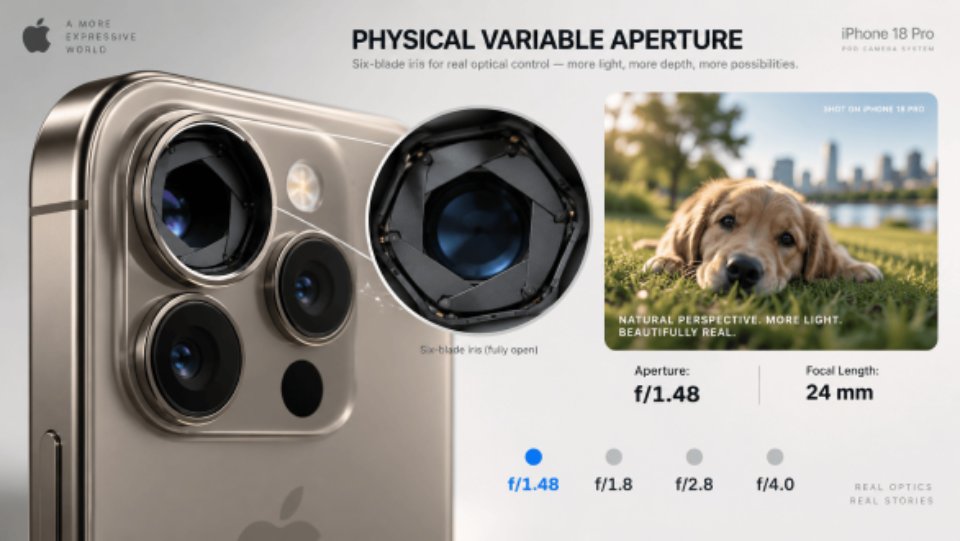
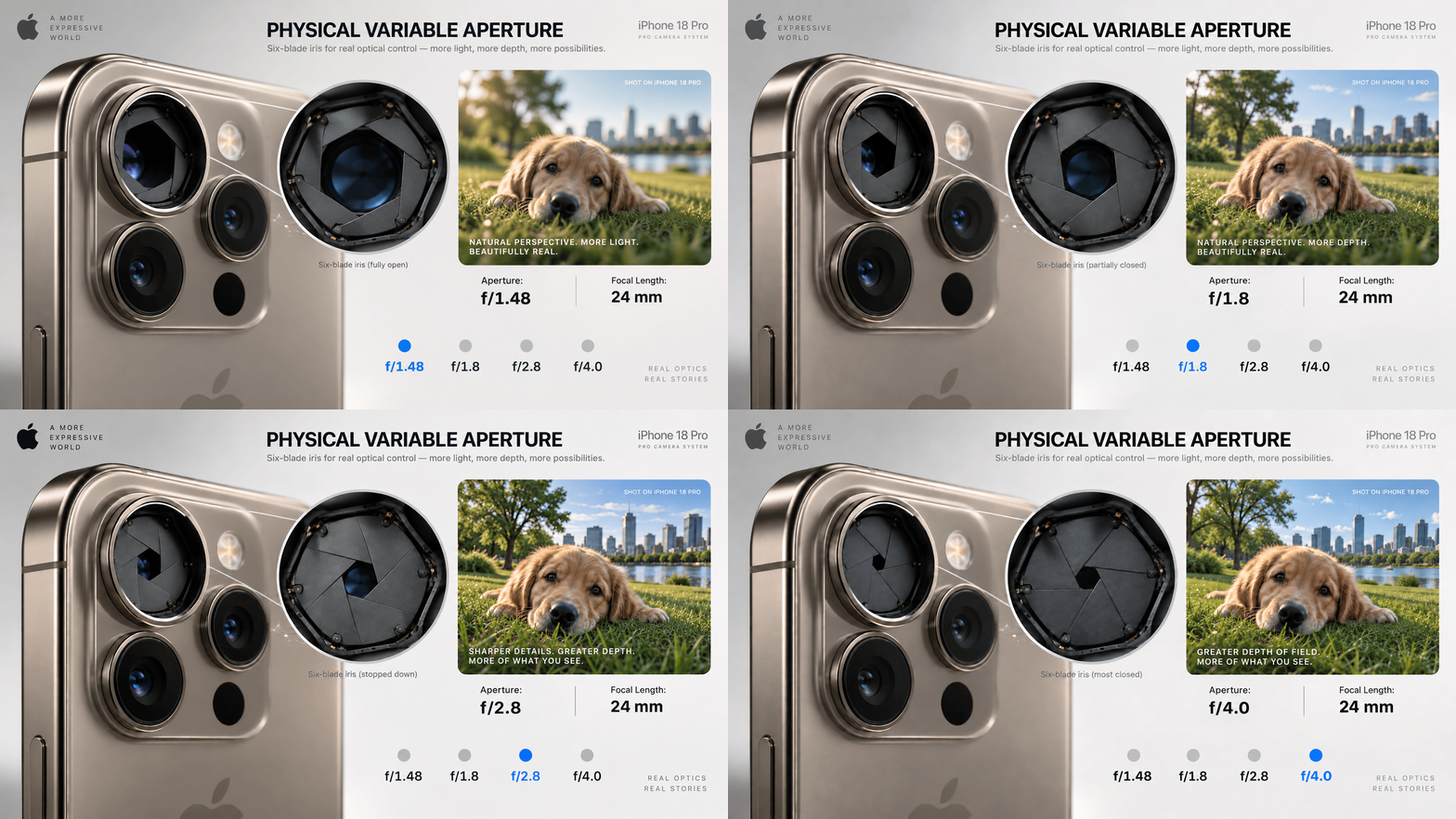
Immediately before iPhone 18 Pro, Apple’s main camera architecture still relied on a fixed physical aperture. That approach favors low-light throughput, but it limits natural optical control in bright scenes. The camera has to lean harder on ISO, exposure time, sensor behavior and software decisions to handle highlight pressure, depth rendering and edge sharpness. A variable iris changes that. Open states such as f/1.48 maximize photon capture; more stopped-down states such as f/2.8 or f/4.0 gives the camera genuine optical control over depth of field, allowing computational depth effects to complement rather than substitute for optical depth rendering.
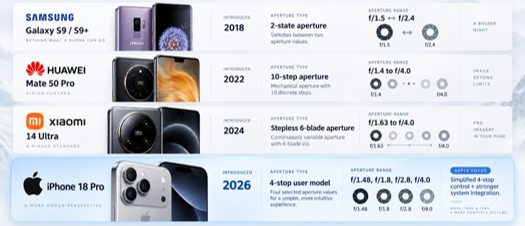
Samsung validated the consumer value of variable aperture with the Galaxy S9/S9+ in 2018, but only as a two-state system. Huawei expanded the idea into a 10-size physical aperture, while Xiaomi moved to a six-blade continuous implementation. Apple therefore was not late to the idea; it was selective about the architecture. The real Apple question was how to deliver variable aperture in a way that fits iPhone constraints on thickness, reliability, user simplicity and camera-stack integration.
2. Apple’s patent architecture: how the R&D path evolved
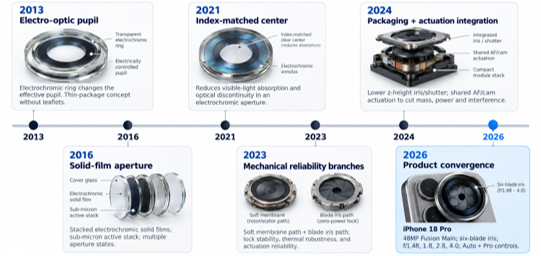
The patent record shows that Apple did not move directly to a six-blade iris. Instead, it explored multiple architectures in parallel: an electro-optic branch, a membrane branch, a blade-and-lock branch, and a later productization branch focused on z-height and actuator sharing.
3. The 2013-2025 shift: from optical concepts to product-ready mechanisms
The earliest Apple branch starts with US20140192256A1, which describes an electro-optic aperture device for a portable camera module. Apple’s idea was to electrically darken an annular electrochromic region, so the effective pupil shrinks without a conventional leaflet iris. US9759984B1 then pushes this into a solid-film architecture, stating that the total thickness of the aperture stack may be less than 1 µm and the substrate may be 0.2 mm or less. US12591162B2 later refine the branch with an index-matched central region so the controllable aperture behaves better optically in visible light.
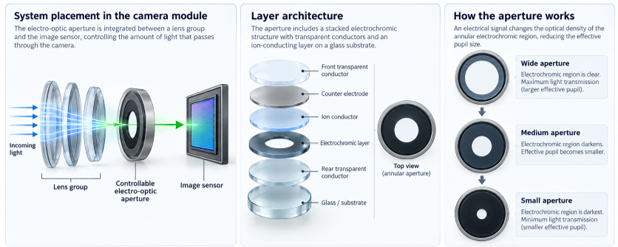
Then the mid-generation patents are important because they show Apple comparing alternative mechanical strategies rather than simply filing around a final design.
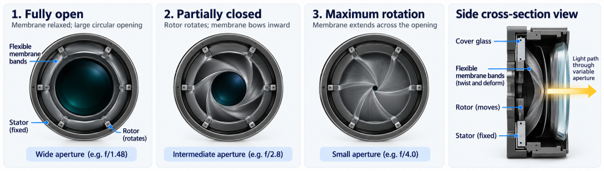
US20250208484A1 proposes a flexible membrane that stretches into the opening as the rotor rotates relative to the stator. This approach is attractive because Apple says it can achieve fewer moving parts, a smaller package and full aperture closure – all useful traits in a smartphone camera.
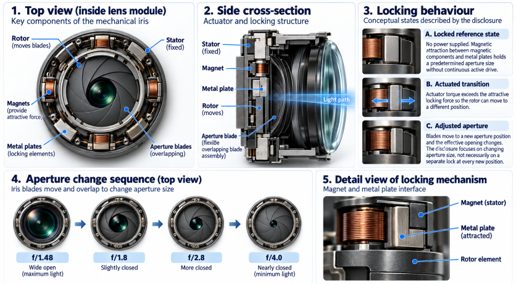
US20250208485A1 instead keeps the more familiar blade iris but adds a zero-power or low-power holding mechanism using magnetic attraction. That matters in a phone camera because the aperture should not require continuous active drive just to stay in position. Because the shipping iPhone 18 Pro also uses a mechanical rotor-and-blade iris, this patent branch is architecturally closer to the announced product than Apple’s earlier electro-optic approaches, although the patent record alone does not establish which disclosed mechanisms are implemented.
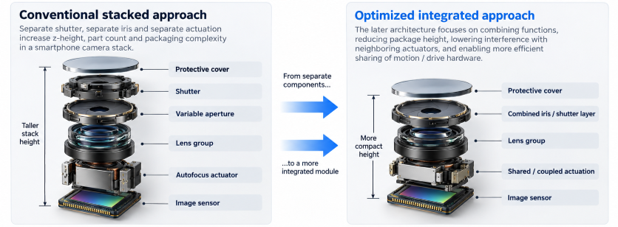
The later branch is about productization. To make the variable-aperture camera architecture product-ready, Apple’s later patent work explores moving from separate optical assemblies toward more integrated architectures. one disclosed architecture combines variable-aperture and shutter functions within a compact blade assembly. A later Apple filing goes further by mechanically coupling motion of the optical assembly to the variable-aperture mechanism, potentially allowing aperture actuation to share motion with the camera’s lens-positioning system instead of requiring a fully independent actuator. This reduces part count and mechanical complexity, potentially improving reliability while lowering camera-module stack height.
4. Why the final iPhone decision appears mechanical
The shipping iPhone 18 Pro implementation is presented publicly as a six-blade mechanical iris with four user-facing stops: f/1.48, f/1.8, f/2.8 and f/4.0. The patent record helps explain why Apple likely converged there. A mechanical iris gives clear repeatable stop positions, an intuitive user model and a direct optical result that works naturally with Apple’s camera stack. Later filings also show Apple working on exactly the issues that would matter before shipping: lock stability, actuator power, package height and sharing motion hardware with nearby camera functions.
IP strategy takeaway
Apple’s advantage was not being first; it was building an IP-backed R&D funnel. The chronology shows Apple maintaining a broad aperture IP portfolio while competitors commercialized different mechanical solutions and then protected the implementation space that would matter for a shipping iPhone. Rather than reflecting a single linear development path, patent history suggests systematic exploration of competing aperture architectures before product convergence..
Variable aperture gives the iPhone greater optical control over light, depth of field, and scene rendering, but what is even more interesting is how Apple coordinates autofocus, exposure, sensor behavior, and computational imaging with the changing aperture a control problem that is still well worth exploring.



Leave a comment: